What does it truly mean to live on Indigenous land in Canada today? What are the stories to explore the laws, and legacies that continue to shape our communities?
In this course, students examine what it means to be Indigenous in Canada by exploring the histories, cultures, identities, and experiences of First Nations, Métis, and Inuit peoples from pre-contact to the present. Students learn about major historical events, treaties, legislation, and contemporary issues affecting Indigenous communities. Through Indigenous perspectives, Introduction to Indigenous Students (INS1155) explores topics related to the environment, social issues, governance, land, language, and the arts. Students engage in reflective practice and community building through discussions, journals, quizzes, and research activities. Students will also demonstrate their learning by conducting original research connected to course themes and developing a deeper understanding of political and legal processes, and reconciliation in Canada.
Required course for: Lethbridge Polytechnic Bachelor of Nursing
Approved Elective for: Lethbridge Polytechnic Bachelor of Agriculture Science, Criminal Justice Corrections, Criminal Justice Policing, Business Administration, Educational Assistant
External Transfer Equivalent at: Athabasca University, Bow Valley College, Keyano College, Mount Royal University, MacEwan University, SAIT, University of Alberta, University of Calgary, University of Lethbridge and University of Regina
Program Details
Eligibility
Open to CBE high school students who:
- Are in grades 11 or 12 during the program
- Are enthusiastic and looking to expand their understanding of the Indigenous culture in Canada
- Are able to commit to the duration of the program
- Are on track to complete or have completed the following courses:
- ELA 20-1 or 20-2 (minimum 60%)
- Social Studies 20-1 or 20-2 (minimum 60%)
Location & Delivery
This course is offered online, asynchronously. Students work through content independently; however, they must meet all course assignments, quizzes, and test deadlines.
Online asynchronous learning is where course materials are accessed digitally without live, real-time meetings. Students learn independently on their own schedule, using resources such as pre-recorded lectures, readings, and discussion boards to complete assignments by specific deadlines.
Duration & Time
- Semester 1 | September to December
- Semester 2 | February to June
Timetable Recommendations
An easier home school course load may be sufficient, depending on the student’s work habits.
Workload
Students can expect approximately 5-8 hours of independent work per week, with additional time required on weeks where there are assessments scheduled.
Program Benefits
- Explore and understand Truth and Reconciliation Calls to Action
- Get a jump start on your post-secondary education while in high school
- Build confidence through developing learning strategies and skills that support your learning transitions
- Taught by experienced instructors who are connected to the industry and support students in making meaningful connections to career pathways
Credits
5 Credits, 30 Level CTS, and
3 Post-Secondary Credits
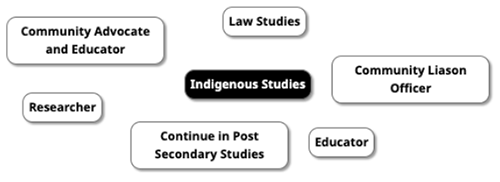
Career Map
Considerations
- Online asynchronous courses offer students flexibility to complete their learning and coursework at times that work for them. However, there are set deadlines and times for quizzes and tests that must be met.
- Students may need adjustments in their school timetable, depending on the rigour of their online course and the other courses they are taking at their home high school at the same time. Talk to your Off-Campus Coordinator about options that may work for you.
- Students must have space in their lives outside of school to complete work for their Dual Credit program in addition to their regular school assignments.
- Students must submit a personal learning schedule with their application, which outlines when they will work on their Dual Credit coursework.
- Students must be registered as a full-time student, taking at least one course at their home high school during the program (work experience excluded).
- Students will be expected to communicate regularly with both their CBE supervising teacher and their course instructor.
How to Apply
- Read through the course(s) and/or program(s) of interest.
- Review program choice with your school Off-Campus Coordinator and/or Guidance Counsellor for program readiness and timetabling concerns.
- You are highly encouraged to attend the Unique Pathways Information Night to ask questions of our program partners and determine if the program is a good fit for you. Connect with your Off-Campus Coordinator or Guidance counsellor if you are unable to attend.
- Download and fill in the Dual Credit Application Form Package when available.
- Refer to the application checklist and ensure all items are complete.
- Book an appointment with your Off-Campus Coordinator and/or Guidance Counsellor before the deadline to complete your application, including signatures from all parties.
- The school will submit the application to Unique Pathways on your behalf.
Contact
Unique Pathways Team
Explore
Last modified: 2026-06-17 19:47:29.973125 +0000 UTC