Three-Year System Student Accommodation Plan (SSAP)
The Three-Year System Student Accommodation Plan identifies schools that have a utilization rate of less than 70 percent or greater than 95 percent, and serves as an indicator to school communities that changes may need to happen in the future. There are several ways we can address challenges identified in the SSAP. These include:
- Changes to the communities a school serves
- Changes to the grades offered in a school
- A school, or a program offered at the school, is considered for closure
- Introduction of alternative programming within a school
What is the SSAP?
SSAP Dashboard
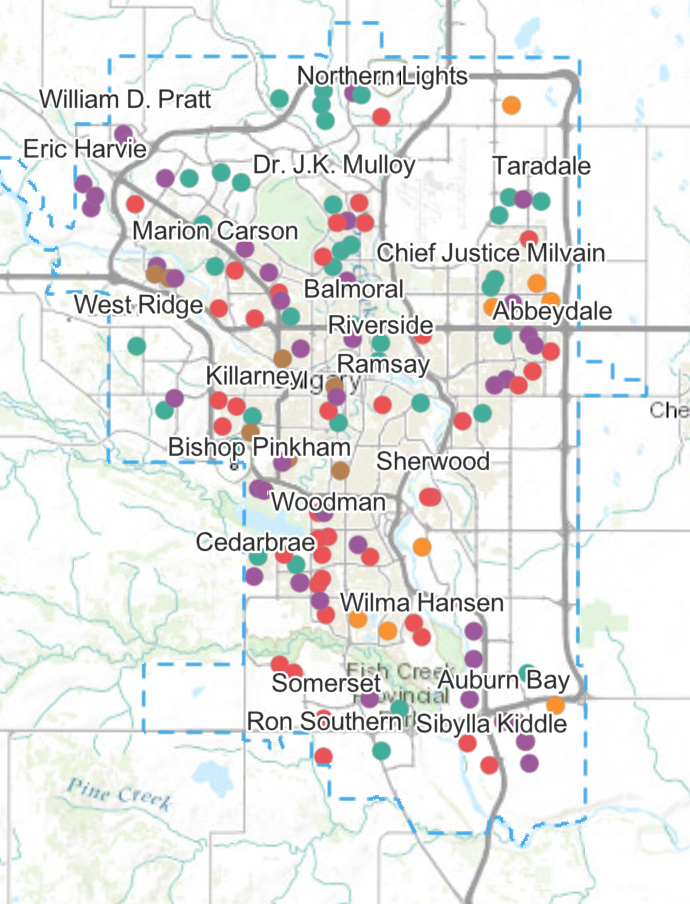
Explore the interactive SSAP Dashboard
for enrolment projections, school utilization and more.
SSAP Process
Develop
Working with the education director and other system leaders, Planning updates the SSAP annually. Accommodation projects are categorized in six different ways:
- Fiscal responsibility/facility optimization
- Low enrolment and/or excess capacity
- Balance enrolment
- Overcapacity and/or nearing capacity
- New school projects
- Plan in place
Communicate
The SSAP is shared as a report for the Board of Trustees each spring. Communication is sent to schools and families informing them of their placement on the plan and what it could mean for the school or group of schools.
Act
Projects are identified for action and timelines are established. Planning works with education directors and system leaders to develop scenarios and proposed plans. Information is shared with affected schools and families and, when possible, feedback may be gathered to help inform the accommodation decision.
Implement
Once an accommodation decision is made, it is shared with the public and implemented in the timeline communicated. Feedback on transition planning may be gathered and communities are kept informed on important upcoming dates.
Factors that Affect Planning Decisions
When the CBE make accommodation decisions, we consider several factors, including our Planning Principles, which are outlined in Administrative Regulation 1090: Student Accommodation Planning Process and listed below:
- Minimize disruptions for students.
- Provide program continuity from kindergarten to Grade 12.
- Keep cohort groups of students together.
- Allow students to attend school as close to home as possible.
- Provide long-term sustainability.
- Use space and resources effectively.
- Provide equitable access for all students to quality learning environments and choice of programs.
We also involve people affected by our decision in the decision-making process, keeping staff, families and students informed through regular communication. When possible, we will ask interest holders for feedback to help us make decisions. In these cases, Planning works with Communication & Engagement Services to determine the appropriate level of engagement based on the CBE’s Dialogue Framework.
When we gather feedback, it is one of many factors we will consider. Planning decisions also consider other factors such as legislation, available budget and resources, transportation considerations and programming needs.
Who Decides on the Changes to Make?
- CBE administration is responsible for making decisions about how space is managed within schools.
- The Board of Trustees is responsible for making decisions where the recommendation involves a consideration of closure.
Review the Three-Year System Student Accommodation Plan, presented to the Board of Trustees in June of each year.
Contact
Last modified: 2026-09-24 00:55:19.041246 +0000 UTC